Buying guide
Solar security cameras in Sydney: battery, solar or plug-in?
Sydney gets plenty of sun for a solar camera. Your wall might not. How to choose between battery, solar and plug-in, where the panel should go, and when solar is wasted money.
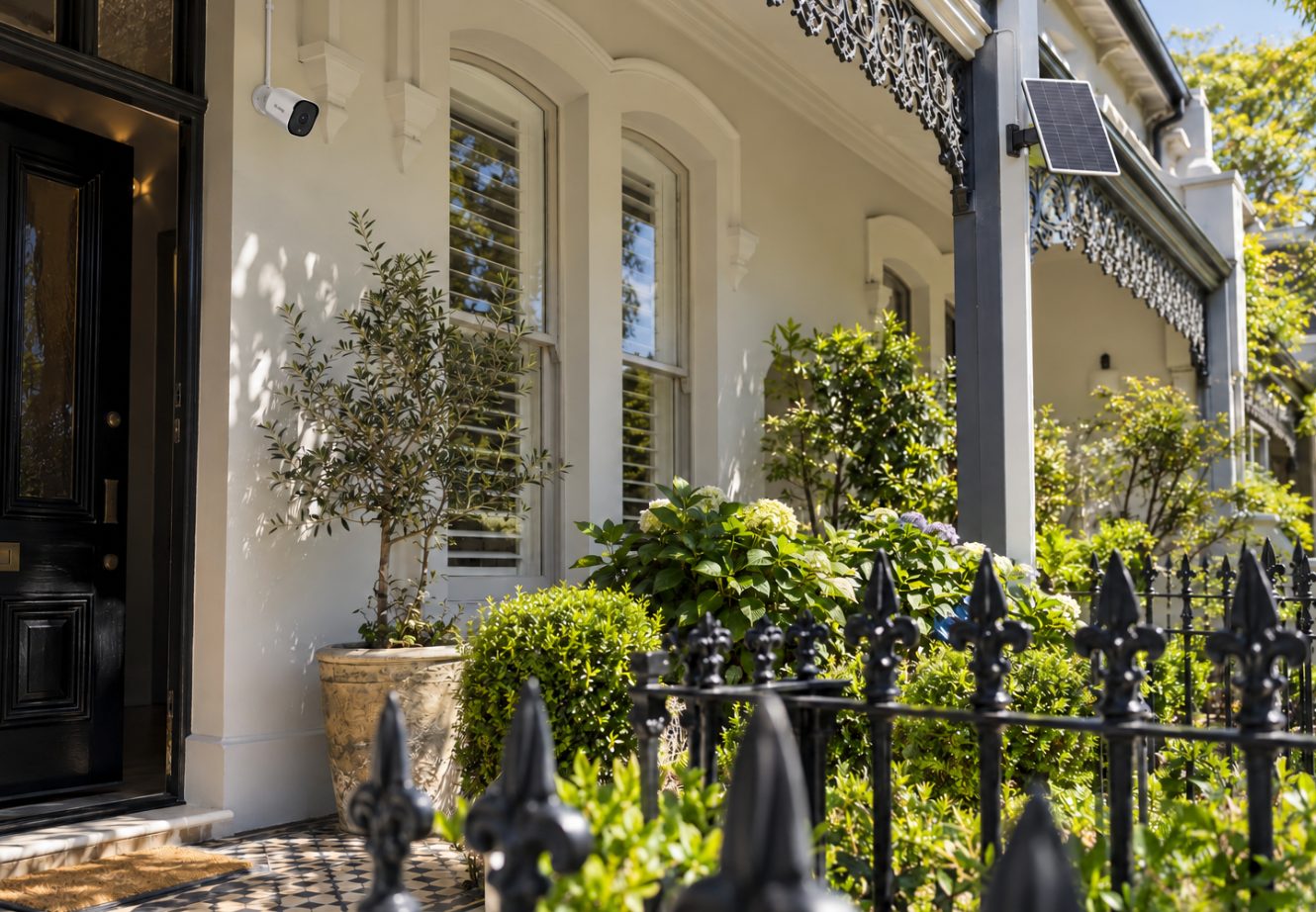
A solar security camera works well in Sydney as long as its panel gets direct sun, which means facing roughly north and clear of eaves, trees and neighbouring walls. The climate is rarely the problem; the wall usually is. If the only spot you have is a shaded, south-facing terrace front, a battery camera you recharge or a plug-in camera is usually the better choice.
Battery, solar or plug-in: the quick comparison
All three are "wire-free" in the sense that nothing runs back to a recorder. The difference is where the power comes from and how much looking after the camera needs.
| Battery only | Battery + solar panel | Plug-in (mains adapter) | |
|---|---|---|---|
| Power source | Rechargeable battery | Same battery, topped up by a small panel | A power point, via an adapter lead |
| Ongoing upkeep | Recharge every few weeks to months | Wipe the panel now and then; check charge through winter | Very little, if the lead is protected |
| Best for | Quiet spots: side passages, back sheds | Walls, fences and carports that get direct sun | Spots within reach of an existing power point |
| Weak point | Busy cameras go flat fast; ladder trips on double-storey homes | Shade, especially in winter | Needs a power point nearby; the lead is visible |
| Power-hungry features | Use sparingly | Use sparingly | No need to ration power |
How long does a battery camera last on its own?
For most front-of-house spots, not as long as the box says. Reolink's battery life figures assume its "Standard Mode", where the camera is awake for about 300 seconds (five minutes) a day. On that basis, its current battery models are rated at anywhere from about 2 months (Argus 4 Pro) to 20 months (Altas) on a full charge.
Real cameras are busier than that. When we logged real Reolink cameras, they were triggered between 34 and 135 times a day, not the 10–15 most people expect. Every trigger wakes the camera, records a clip and usually sends a notification. If each wake-up lasts 20 seconds, 100 triggers is more than half an hour awake, so a camera facing a footpath in Newtown or Randwick may get only a fraction of its rated battery life.
Two more things worth knowing:
- Reolink says its batteries can be recharged about 500 times. Like a phone battery, they slowly lose capacity as they age.
- On a double-storey home, every recharge means getting the tall ladder out. That hassle is the main reason people add a solar panel.
Battery-only still makes sense where a camera rarely triggers, such as a back shed or a side gate nobody uses. Set tight motion zones and check the battery percentage in the app once a month.
Does Sydney get enough sun for a solar camera?
Yes, comfortably. Bureau of Meteorology records for Sydney (Observatory Hill) average 5.5 hours of sunshine a day in June, the dullest month, rising to 7.8 hours in November and 6.8 hours across the year. Those sunshine figures come from 1955–1992 records at a station that has since closed, but they're still the best long-run guide for inner Sydney.
Reolink says its bundled 3W and 6W panels need just 10–20 minutes of sun a day to keep a camera running in Standard Mode. Real-world use takes more than that, but the margin is big. If a solar camera in Sydney keeps going flat, the cause is almost always where the panel is, not the weather.
South-facing walls
In the southern hemisphere the sun crosses the northern sky, so Reolink's guidance is to face panels north. By our calculation from Sydney's latitude, the midday sun in midwinter is only about 33 degrees above the northern horizon. From late March to late September, a wall facing due south gets almost no direct sun at all, which is exactly when the battery needs topping up most.
That rules out the front wall of a lot of Inner West terraces and Eastern Suburbs semis whose street side faces south. The camera can still point at the street. The panel just has to go somewhere else.
Eaves and verandahs
Cameras usually go under the eaves for shelter and a good downward view. The panel shouldn't: Reolink specifically says to avoid eaves and covered areas. An eave shades the wall below it for much of the day, especially in summer when the sun is high, and a deep front verandah or carport roof does the same.
Trees, neighbours and winter shadows
Reolink warns that a panel's output "drops drastically even when a small portion" of it is blocked. In tight streets the usual culprits are a neighbour's second storey, a street tree or a big tree over the back fence. With the sun so low in winter, a spot that's sunny in October can sit in shadow all day in June. Judge the spot by its winter shadows, not by how it looks on a spring afternoon.
Where to put the solar panel: a checklist
- Face it as close to north as you can. North-east or north-west still works. South is the one to avoid.
- Tilt it about 40 degrees. Reolink gives latitude plus 5 degrees as the ideal, which is about 39 degrees in Sydney, and says 40–45 degrees works well all year.
- Never mount it flat. Dust, leaves and droppings settle on a flat panel and cut its output.
- Check for shade at all times of day. Clear of eaves, aerials, trees and neighbouring walls in the morning and afternoon, not just at noon.
- It doesn't have to sit next to the camera. The Reolink panel comes with a 4 m lead. Reolink advises no more than 9 m of its own extension cables on top, and recommends against other brands' extensions.
- Make sure you can reach it with a cloth. Reolink recommends wiping the panel regularly.
- Watch the battery for a week. Over a few sunny days the battery level in the app should rise or hold steady. If it drops day after day, the panel isn't keeping up.
One more limit: Reolink says to charge its 3W, 6W and 12W panels' cameras between 0°C and 45°C, and the camera won't charge below 0°C. Inner Sydney rarely gets near freezing, so for most homes this is a non-issue.
When is solar a waste of money?
Skip solar, or think again, if:
- The panel can only go in shade. South walls, deep verandahs, under carports or under dense trees. A panel that never sees direct sun is just decoration.
- The camera hardly ever triggers. A camera that records a handful of events a day may go months between charges. A panel adds cost and one more thing to mount.
- There's already a power point within reach. A plug-in camera never needs charging at all.
- The camera is very busy and the settings are wrong. Even good sun may not keep up with a camera that triggers hundreds of times a day. Fix the triggers before you buy a bigger panel.
On that last point, the numbers can be dramatic. When we switched a busy business driveway camera to person-only detection with a detection zone, its recordings dropped by about 97%, from around 1,300 a day to under 40. A single cobweb in front of another camera caused over 9,000 recordings in a few days. No battery keeps up with that. Reolink's own advice is similar: limit live viewing, lower PIR sensitivity, use detection zones, or move up to a bigger panel. Our guide to fixing false alerts from spiders and trees goes through it step by step.
Also check compatibility before buying. Reolink says its solar panels charge all of its battery cameras except the Keen. Other brands use their own panels and connectors.
What about plug-in cameras?
A plug-in camera runs from a power point through an adapter, so there's no battery to watch and no panel to place. It also doesn't have to ration power. Reolink notes that features like continuous recording and pre-recording increase power use on its battery models, which doesn't matter on mains power.
The catch is that you need a power point within reach, and the lead needs to be neat and protected from the weather. A garage, a carport with an existing outlet or an alfresco area often works. A blank front wall usually doesn't.
Putting in a new outdoor power point is electrical wiring work, and NSW Fair Trading says you must hold an electrical licence to do any electrical wiring work in NSW. That's general information, not legal advice. We don't do electrical work, so if you want a new power point, get a licensed electrician in first and mount the camera afterwards. If you're renting, battery or solar is usually the easier conversation with your landlord. Our guide to security cameras in a NSW rental covers what to ask.
How much does solar camera installation cost in Sydney?
At WireFree Security, a standard installation for one camera starts from $149. A solar camera installation starts from $199 for one camera and $389 for two. Double-storey or high access adds from $100 per camera, and masonry or other difficult surfaces add from $40 per camera. If there's no usable Wi-Fi where the camera needs to go, a 4G solar camera starts from $249 for the first one, plus SIM activation and set-up from $75. The full list is on our installation prices page.
When we supply Reolink cameras, we fit a 64GB memory card. On average that holds around six months of motion-triggered recording, but it depends heavily on how often the camera is triggered. Our 64GB SD card guide explains the maths.
The short version
- Sunny wall or fence, and a camera that triggers a lot: battery plus solar, with the panel facing north at about 40 degrees.
- Shaded or south-facing spot: mount the panel somewhere sunnier within cable reach, or skip solar.
- Quiet spot: battery only, recharged a few times a year.
- Power point right there: plug-in.
Whatever you choose, set your motion zones before you judge the battery. A badly set up camera will flatten any power source.
Common questions
Do solar security cameras still work on cloudy days?
Yes. The camera runs from its battery, and the panel tops it up whenever there's enough light. Cloud and rain cut charging, so a run of grey days can slowly drain the battery. Bureau of Meteorology records for Sydney (Observatory Hill) average about 133 cloudy days a year, so a decent battery reserve and a well-placed panel matter more than the panel's size. Check the battery level in the app after a wet week.
Do solar cameras work at night?
Yes. The solar panel charges the camera's battery during the day, and the camera runs from that battery overnight, including its night vision and motion detection. The panel itself produces no power in the dark. What matters is whether daytime charging covers a full 24 hours of use. If the battery drops a little every day, reduce unnecessary triggers or find the panel a sunnier spot.
Is a 6W solar panel better than a 3W panel?
It puts out more power, which helps a busy camera or a spot that only gets a few hours of sun. In Reolink's sunny-conditions figures, most models bundled with the 6W panel charge at roughly 10–21% per hour, against roughly 7–11% for 3W bundles. Large-battery models like the Altas show lower percentages because there's more battery to fill. A bigger panel won't fix one that sits in shade. Check the panel suits your camera model first.
How often should I clean a security camera solar panel?
Reolink recommends wiping its panels regularly with a soft cloth to remove dust, leaves and bird droppings. In practice, check the panel every few months, and after windy, dusty weather. Panels under trees or near where birds roost need it more often. A battery level that's falling slowly in sunny weather is often the first sign the panel needs a wipe. Don't mount the panel flat, because debris settles on it much faster.
Can the solar panel go on the roof or a different wall from the camera?
Often, yes. The panel doesn't need to sit next to the camera. Reolink's panel comes with a 4 m lead, and Reolink advises no more than 9 m of its own extension cables on top. That's usually enough to reach a north-facing fascia or fence from a camera on a south-facing front. Mounting at double-storey height counts as high access when an installation is priced.
Sources
- Climate statistics for Australian locations – Sydney (Observatory Hill) — Bureau of Meteorology
- Understanding and Optimizing Reolink Solar Panel Efficiency — Reolink Support
- How Long Does the Battery Last for Battery-powered Cameras — Reolink Support
- How to Use Solar Panel — Reolink Support
- Electricians – Compliance and regulation — NSW Fair Trading
General information, not legal advice. Prices are “from” prices; your quote depends on the site.